

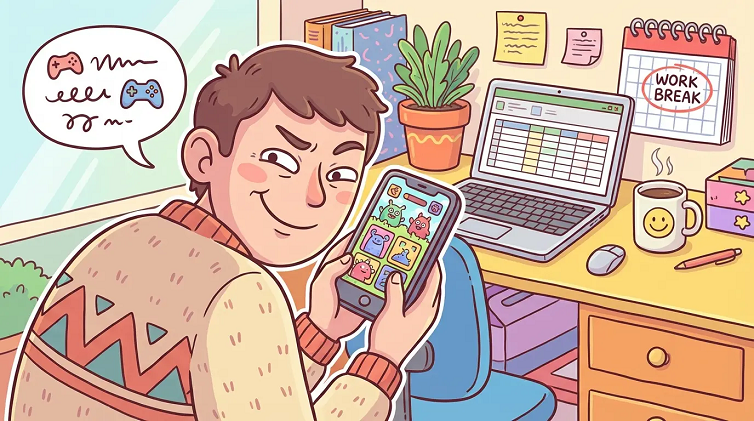
Anyone who works at a screen knows the trap of the short break. You have five minutes between tasks, you reach for your phone to decompress, and forty minutes later you surface from a feed with less focus than before you started. The break was supposed to recharge you. Instead it drained you.
The problem isn’t taking breaks — breaks are essential for sustained productivity. The problem is that endless feeds are engineered to never let you stop, which is the opposite of what a mental reset requires.
What a real reset actually needs
Cognitive research points in a consistent direction: to recover focus, the brain needs a short activity that is absorbing but bounded. Absorbing enough to pull your attention off the task you were grinding on; bounded enough that it ends on its own and hands you back to work.
Social feeds fail the second test by design. There is no natural stopping point, so willpower alone has to end the break — and willpower is exactly the resource you were trying to restore. A short game with a clear finish line does the opposite: it gives your mind a single contained problem, you solve it, and it’s over.
The unlikely case for the simplest game of all
You don’t need anything elaborate. In fact, the simpler the better, because a complex game creates its own rabbit hole. This is why an old classic like tic tac toe turns out to be close to ideal for a work break.
A single round takes a minute or two. It asks for just enough thought to occupy your mind without stressing it — no timer, no leaderboard, no notifications trying to reel you back in. And crucially, it ends. You win or draw, you close the tab, and you return to your desk with your attention gathered rather than scattered.
For anyone who finds it too easy, the modern versions add a twist worth knowing about: larger boards. On a 5×5 or 7×7 grid the game stops being a guaranteed draw and starts demanding real forward planning, which makes it a genuinely engaging thirty-second puzzle rather than a reflex.
How to use micro-breaks without losing momentum
A few simple rules keep a game break from becoming another distraction:
- Pair it with your work rhythm. Take one round after finishing a focused block, not in the middle of one.
- Pick something with a built-in end. A single game round beats an open-ended feed every time.
- Keep it off the app store. A browser game means no install, no account, and no engagement mechanics designed to keep you playing.
If you want to try the approach, a no-friction option is Tic Tac Toe Online, which runs straight in the browser on desktop or phone — boards from 3×3 up to 7×7, difficulty levels, and a two-player mode — with nothing to download and no sign-up to pull you in.
Small habit, measurable payoff
Protecting your focus across a workday isn’t about willpower; it’s about choosing breaks that actually restore rather than deplete. Swapping a few doomscroll sessions for a quick, finite game is a tiny change, but it keeps your attention sharper deeper into the day. Next time you hit a lull, try one round instead of the feed — and notice how much easier it is to get back to work.